HealthJune 2026
Pilates for Hip Pain
Which Pilates exercises relieve hip flexor tightness, bursitis, and labral irritation.
Read → 11 min read
Updated June 2026 · 11 min read
Knee pain is the second most common musculoskeletal complaint after back pain — affecting runners, desk workers, older adults, and former athletes in roughly equal measure. Pilates addresses knee pain indirectly but effectively: by strengthening the hip and thigh muscles that control knee alignment, it removes the upstream cause of most non-traumatic knee conditions. Understanding which exercises help and which to avoid is the difference between recovery and aggravation.
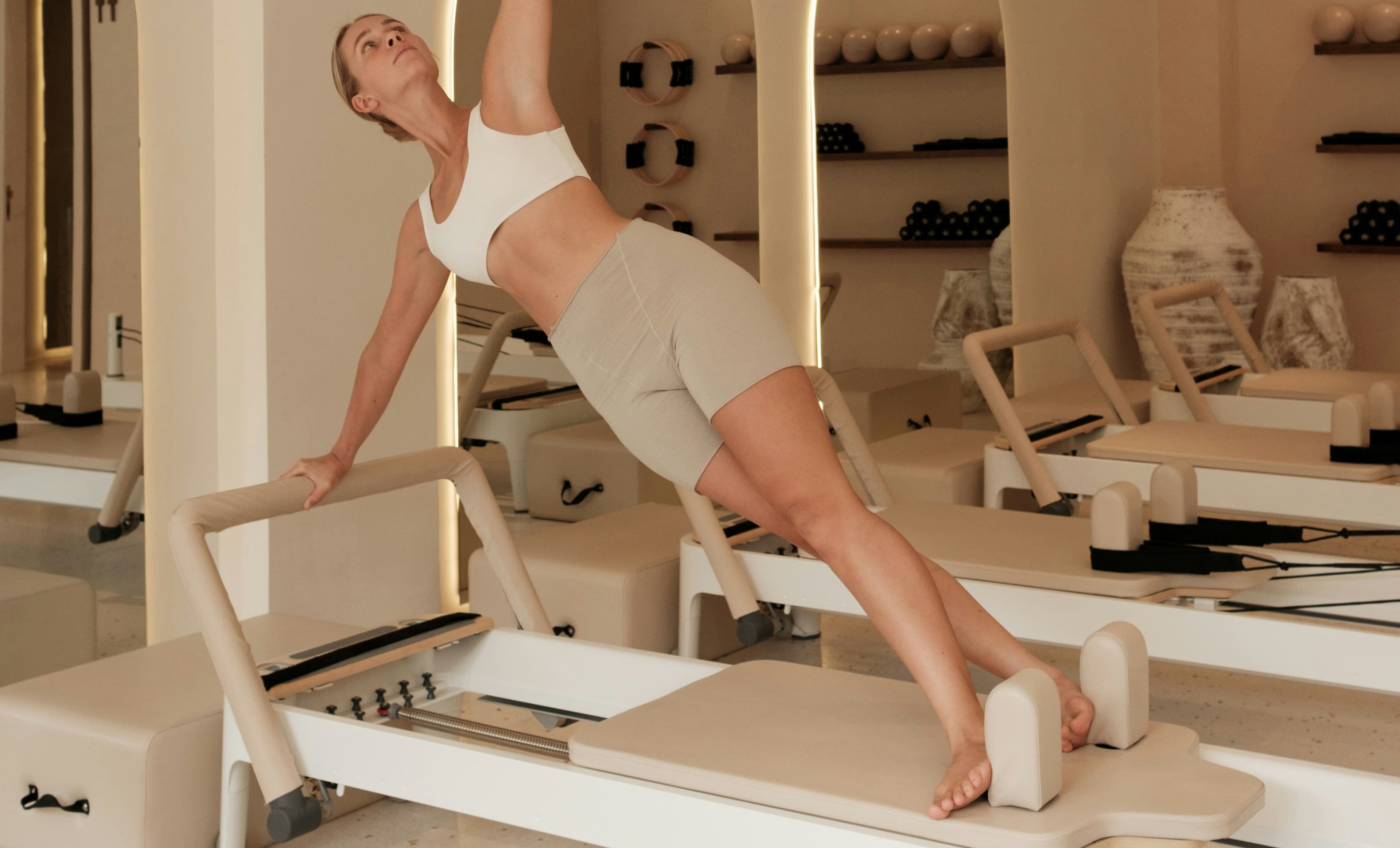
The knee joint itself is relatively simple — a hinge joint with limited degrees of freedom. What makes it vulnerable is its position in the kinetic chain: it sits between the hip above and the ankle below, and its alignment during movement is entirely determined by how well the muscles of both joints control it. When the glute medius (lateral hip) is weak, the femur internally rotates during weight-bearing — pulling the patella laterally and creating the friction and pain of patellofemoral syndrome. When the vastus medialis oblique (inner quad) is weak, the patella tracks laterally in the groove regardless of what the hip is doing.
This is why treating knee pain at the knee — with knee-specific exercises only — is often insufficient. Pilates' emphasis on hip stability, glute strength, and lateral chain development addresses the upstream causes of knee pain in a way that many conventional rehabilitation approaches miss.
This does not mean Pilates is appropriate for all knee conditions. Acute injuries (ligament tears, meniscus tears, acute bursitis) require assessment and initial management before exercise. Structural conditions like significant osteoarthritis or post-surgical knees require specific programming. But for the vast majority of chronic, activity-related knee pain — patellofemoral syndrome, IT band syndrome, chondromalacia, and generalised anterior knee pain — Pilates provides a highly effective, evidence-supported approach.
Clam (side-lying) — the most important
Lying on your side, knees bent at 45°, feet together, you open the top knee as far as possible without rotating the pelvis. This directly activates the glute medius — the hip abductor responsible for femoral alignment during all weight-bearing activities. Weak glute medius is the most common finding in all forms of patellofemoral pain. Add a light resistance band above the knees to progress. 15 repetitions each side, 3 sets.
Reformer footwork (supine, spring-loaded)
The foundational reformer exercise loads the quads, glutes, and hamstrings in a supported position. The key for knee pain is setting the footwork range to avoid deep knee flexion — keep the carriage movement within the first 90° of knee bend (feet at full extension, never letting the knees go past 90° at the closest point). This loads the VMO (inner quad) directly while keeping the knee in a safe range. Parallel position, V-position, and calf raise variations are all appropriate.
VMO (vastus medialis) activation — terminal knee extension
Sitting in a long-sit position or standing with a resistance band around the knee, you focus on the last 15–20° of knee extension — the range where the VMO is most active. This isolated VMO strengthening directly improves patellar tracking. The sensation should be a strong contraction at the inner knee, just above the patella. 3 sets of 15, slow controlled movement.
Side-lying hip abduction series
Building beyond the clam, the side-lying leg series (top leg lift, circles, front/back, bicycle) develops the full lateral hip musculature that controls femoral alignment. These exercises load the knee minimally while directly strengthening the muscles that protect it. Appropriate for all knee pain presentations including post-surgical.
Bridge (bilateral and progressive to single-leg)
Bridge loads the glute max and hamstrings in terminal hip extension — the most important single position for knee protection during walking and stair climbing. The bilateral bridge is appropriate from the beginning; single-leg bridge is a progression that significantly increases the challenge. Avoid if the exercise provokes sharp knee pain at the back of the knee (possible popliteal involvement).
Standing balance work with minimal knee flexion
Standing single-leg exercises with only a small amount of knee bend (20–30°) develop the proprioceptive control and lateral hip stability that the knee needs during functional movement. Wall-supported versions are appropriate during acute phases. Unsupported standing exercises are a later progression.
Patellofemoral pain syndrome (runner's knee)
Prioritise glute medius strengthening (clam, abduction series) and VMO activation. Avoid deep knee flexion and downhill-equivalent loading until pain resolves. Progress to single-leg exercises once glute strength is established.
IT band syndrome
Hip abductor and TFL work is key — not aggressive IT band stretching (which is largely ineffective). Side-lying series and clam variations are the foundation. Address running volume if relevant alongside Pilates work.
Knee osteoarthritis
Exercise is a first-line treatment per NICE guidelines and the Royal College of GPs. The reformer footwork series — lying supine with calibrated spring resistance — is one of the most appropriate exercises for knee OA because it loads the joint in controlled ranges without impact. Avoid deep flexion. Expect 6–8 weeks for meaningful pain reduction.
Chondromalacia patellae
Same as patellofemoral protocol — VMO activation and glute strength are the primary targets. Additionally focus on avoiding compressive patellofemoral positions (deep squats, stairs with pain). Pool-based Pilates (if available) is appropriate during acute phases.
Post-ACL reconstruction
Pilates is appropriate in later rehabilitation phases (typically 3+ months post-surgery) under physiotherapy guidance. The reformer footwork is often among the first exercises reintroduced because it is closed-chain (foot pressed against surface) and controllable. Never progress faster than your surgical team recommends.
Is Pilates safe after knee replacement surgery?
Pilates can be part of rehabilitation after knee replacement (total or partial arthroplasty), but timing and exercise selection must be guided by your orthopaedic surgeon and physiotherapist. Gentle reformer footwork (lying supine, pressing through the foot) and upper body Pilates are typically introduced in the weeks after surgery. Full mat work and standing exercises are introduced progressively as healing allows. Never start Pilates post-surgery without clearance from your surgical team.
Can Pilates help runner's knee (patellofemoral pain)?
Yes — patellofemoral pain (runner's knee) is primarily driven by hip abductor weakness causing the femur to internally rotate and the patella to track laterally. Pilates glute medius work (clam, side-lying abduction) addresses this root cause directly. A 2019 randomised controlled trial found that hip-strengthening exercises reduced patellofemoral pain more effectively than knee-specific exercises alone. Pilates is particularly well-suited because it combines hip strengthening with body awareness training.
What Pilates exercises should I avoid with knee pain?
Deep squats and lunges (more than 60–70° of knee bend) are the primary exercises to avoid if you have anterior knee pain. Full kneeling positions can aggravate patella bursitis. Standing exercises on an unstable surface are inappropriate during acute knee pain flares. On the reformer, avoid exercises that load the knee at full flexion (deep footwork, hamstring curls with the foot too close to the carriage) during acute presentations.
Is mat or reformer Pilates better for knee pain?
Reformer Pilates offers significant advantages for knee pain because most exercises are performed lying down with the knee supported. The footwork series — the foundational reformer exercise — loads the knee in a controlled, supported way at calibrated angles. Mat Pilates can be equally effective but requires more careful exercise selection to avoid loaded kneeling and deep knee flexion. A one-on-one reformer session with a clinically-informed instructor is the best starting point for anyone with significant knee pain.
Equipment
6mm cushioning protects the knees during floor-based Pilates work — particularly important for exercises involving kneeling or side-lying leg series.
Shop on AmazonUsed before Pilates to release IT band, quad, and calf tension that commonly aggravates knee pain. The GRID pattern provides deeper tissue access than smooth rollers.
Shop on AmazonLight-to-medium resistance bands for glute and hip strengthening — the key upstream intervention for most knee pain presentations.
Shop on AmazonUsed for inner thigh activation and knee alignment cues throughout the mat repertoire — a staple in clinical Pilates for knee conditions.
Shop on AmazonProvides resistance for hip adductor and abductor work — muscles that directly influence knee tracking and stability.
Shop on AmazonUse our curated city guides to find the best Pilates studios worldwide.
Explore City Guides →