PerformanceMay 2026
Pilates for Athletes
How professional athletes use Pilates for injury prevention and performance enhancement.
Read → 9 min read
Updated May 2026 · 11 min read
Runners who add Pilates to their training often describe the same experience: a gradual disappearance of the niggles that had become background noise — the hip that tightened after long runs, the knee that ached on descents, the lower back that stiffened after speed work. This isn't coincidence. Pilates systematically addresses the specific movement deficits that running both requires and creates. This guide explains the mechanism, the exercises that matter most, and how to structure Pilates within a running programme.
Running is a unilateral, sagittal-plane dominant activity — meaning it loads one leg at a time in a forward-backward movement pattern, repeated thousands of times per run. This creates predictable imbalances: overactive hip flexors (from repetitive hip flexion), underactive glute medius (from inadequate lateral hip control), tight thoracic rotation (from arms swinging across a stiffened torso), and shallow diaphragmatic breathing under load.
Most running injuries are not acute trauma. They are the accumulated product of these imbalances expressed over thousands of repetitions. Runner's knee, ITBS, plantar fasciitis, and lower back pain are all downstream effects of the same upstream movement problems. Pilates does not cure these conditions by treating symptoms — it addresses the root patterns.
The mechanism is threefold: Pilates develops the deep stabilising musculature (multifidus, transversus abdominis) that manages spinal load during the running gait cycle; it restores lateral hip and rotational capacity that running doesn't train; and it develops the breath control that separates efficient runners from those who fatigue early and lose form.
Glute medius activation and hip stability
The glute medius is the primary lateral hip stabiliser — responsible for preventing the pelvis from dropping to the unsupported side during single-leg stance (which occurs at every step in running). Weakness here is the most common finding in injured runners and the most common deficit that Pilates addresses. Side-lying leg series, clam, and side-lying abduction exercises in the Pilates mat and reformer repertoire specifically target this muscle in ways that running does not.
Thoracic rotation and arm swing efficiency
Running efficiency depends partly on the counterrotation of the upper and lower body — the arms swinging opposite to the legs requires thoracic spine rotation. Runners with stiff thoracic spines compensate with excessive lumbar rotation (a primary contributor to lower back pain) or lose the counterrotation entirely (reducing efficiency). The rotation exercises throughout the Pilates repertoire — spine twist, saw, corkscrew — systematically restore thoracic mobility that running doesn't develop.
Hip flexor length and psoas function
Repetitive hip flexion shortens the hip flexors over time. A tight psoas affects both running mechanics (reduced hip extension reduces stride length) and recovery (continued tension on the lumbar vertebrae at rest). Pilates addresses this from both ends: hip flexor lengthening through extension exercises (swan, swimming, long stretch series) combined with strengthening the psoas through its eccentric function — controlling hip extension — rather than its shortening action.
Respiratory efficiency and diaphragm function
Breathing in Pilates is not optional or incidental — the breath is integrated into every exercise as a biomechanical tool. The emphasis on full exhalation (facilitating deep transversus abdominis engagement) and three-dimensional ribcage breathing develops diaphragm function that directly improves oxygen efficiency during running. Runners who practise Pilates regularly consistently report improved breathing economy at threshold efforts.
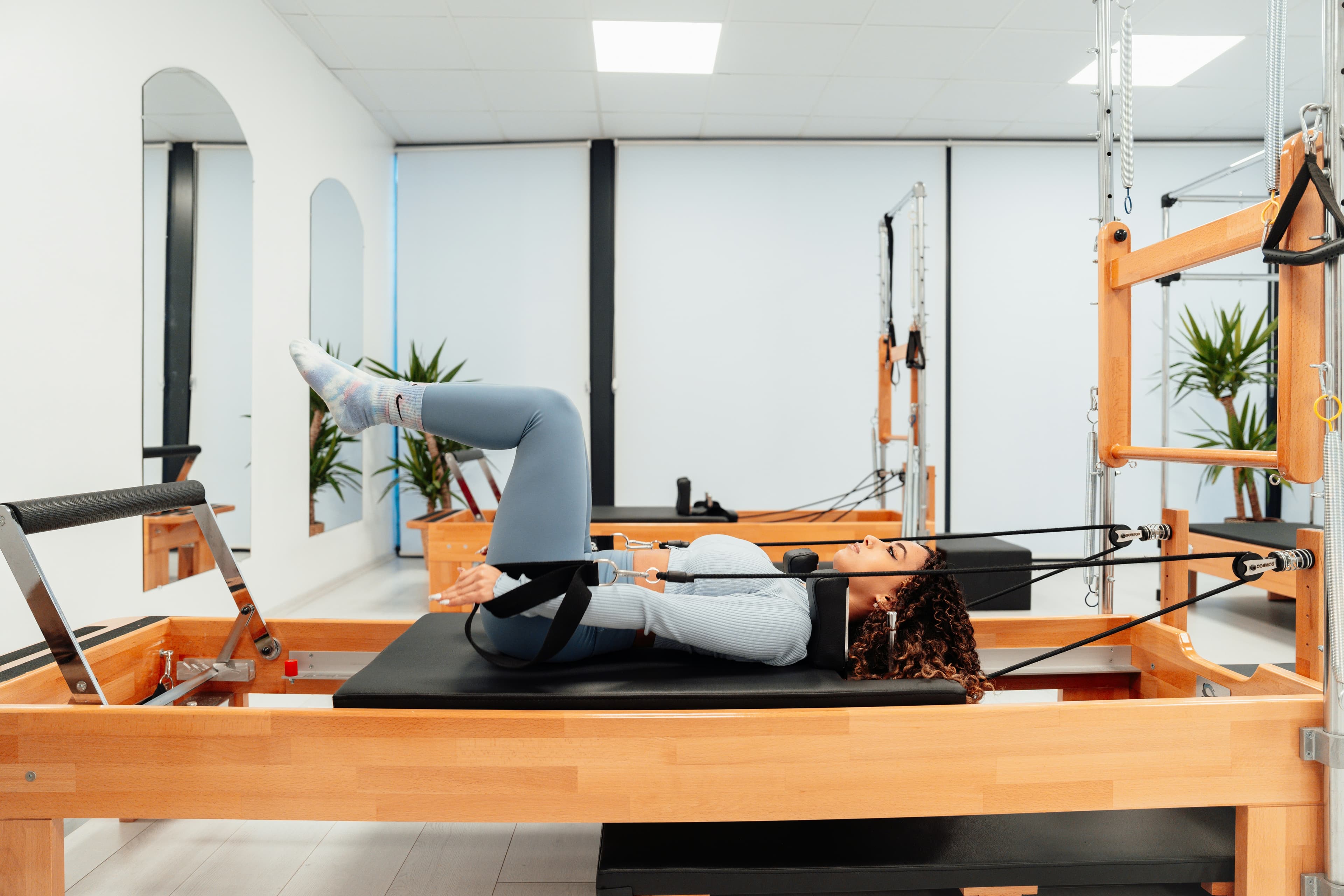
Both reformer and mat Pilates benefit runners, but they do so differently. Reformer work allows more targeted loading of specific hip and glute patterns — the footwork series, side-lying leg work, and long stretch series on the reformer are particularly effective for runners because spring resistance can be calibrated precisely to the required challenge level.
Mat work develops the foundation of deep stability that makes reformer exercises more effective. The classical mat sequence — particularly the side series, back extension exercises, and rotational movements — is accessible, requires no equipment, and can be performed on any rest day. Many elite running coaches now recommend a 15–20 minute mat Pilates sequence on recovery days specifically because it active-recovers without adding load.
For injury prevention, one reformer session per week in addition to a short mat practice on two other days represents the most effective combination based on what works in practice. For rehabilitation from a specific running injury, clinical Pilates (one-on-one reformer sessions with a qualified physiotherapist-Pilates instructor hybrid) is more appropriate than group classes.
This 20-minute mat sequence targets the specific deficits most runners present. Perform on easy recovery days — not immediately after hard efforts.
How often should runners do Pilates?
Once or twice per week is the most commonly recommended frequency for injury prevention — one reformer class and one mat session being the most effective combination. More than three sessions per week begins to compete with running recovery time. Consistency over months matters more than frequency in any given week.
Will Pilates make me slower by adding muscle mass?
No. Pilates develops type I slow-twitch muscle fibres and neurological efficiency — neither of which adds significant mass. The strength gains are specific to stability and control patterns, not hypertrophy. Most runners who add Pilates report improved economy and pace at equivalent effort, not any weight or speed penalty.
Should I do Pilates before or after my runs?
After easy runs or on dedicated rest days. Pilates sessions that include significant core work reduce the explosive reactivity of the core stabilisers temporarily — running immediately after a demanding Pilates session is not ideal. A short, gentle mat sequence (10 minutes) is appropriate as a post-run cooldown; a full 55-minute reformer session works best on a separate day.
Can Pilates help with runner's knee?
Yes — patellofemoral pain (runner's knee) is typically driven by hip abductor weakness causing the femur to internally rotate and the patella to track laterally. Pilates glute medius work directly addresses this. Significant improvement is typically reported within 6–8 weeks of consistent Pilates practice combined with appropriate running load modification.
Equipment
The standard myofascial release tool for runners using Pilates. IT band, calf, quad, and hip flexor rolling before Pilates sessions improves the quality of the movement work and accelerates recovery.
Shop on AmazonHip abductor and glute strengthening between sessions. The glute medius weakness that causes most running injuries is precisely what Pilates resistance band work targets.
Shop on AmazonRunners need a stable, high-density mat for the hip and core work that makes Pilates most effective as a running complement. A non-slip surface matters during single-leg balance work.
Shop on AmazonHip adductor and abductor resistance work to complement the unilateral strength that running develops. Efficient for the lateral hip work runners most commonly neglect.
Shop on AmazonUsed for hip and glute activation during mat Pilates — between the knees during bridging, it activates the adductor-glute chain that stabilises the pelvis during running gait.
Shop on AmazonUse our curated city guides to find the best Pilates studios worldwide.
Explore City Guides →