GuideApril 2026
Pilates for Weight Loss
What Pilates does and doesn't do for weight loss — the honest, evidence-based answer.
Read → 7 min read
Updated June 2026 · 8 min read
The short answer is yes — but the degree depends on who you are, what kind of Pilates you do, and how you define muscle building. Pilates unambiguously improves muscle activation, endurance, and tone. Whether it produces the hypertrophy (increase in muscle fibre size) associated with strength training is a more nuanced question. Here is what the evidence actually shows.
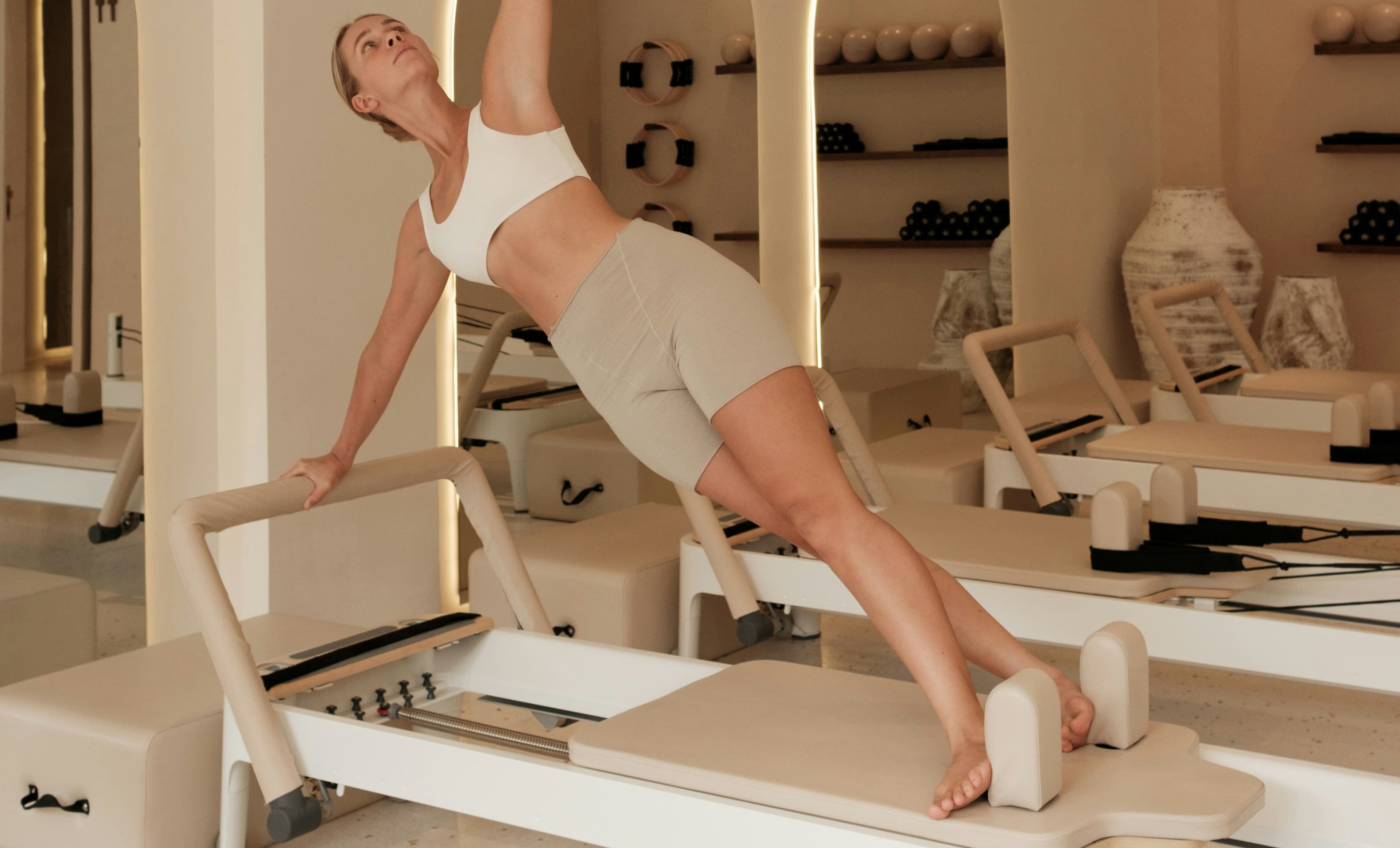
Multiple studies have measured the effect of Pilates on muscle mass and strength. The findings are consistent: Pilates produces significant improvements in muscular endurance, core strength, and functional movement quality. It produces moderate hypertrophy in previously sedentary or deconditioned individuals. It does not produce the same hypertrophic response as progressive overload resistance training in already-active individuals.
A 2015 study in the Journal of Sports Medicine found that 12 weeks of Pilates produced significant increases in abdominal and lumbar extensor strength in sedentary women. A 2021 meta-analysis confirmed Pilates improves muscle endurance and functional strength consistently across populations, with greater effects in older adults and those new to exercise.
Core musculature
The transverse abdominis, multifidus, and pelvic floor — the deep stabilisers that most gym programmes neglect — show consistent strength and activation improvements with Pilates across all populations.
Glutes and hip stabilisers
The gluteus medius and external hip rotators, undertrained by most gym programmes, are primary targets in reformer footwork and mat hip series. Measurable strength gains in these muscles are well-documented.
Shoulder and scapular stabilisers
The serratus anterior, lower trapezius, and rotator cuff muscles — essential for shoulder health — are consistently challenged by Pilates arm series and show functional strength improvements.
What Pilates does not do
Without progressive overload beyond bodyweight, Pilates does not produce the sustained hypertrophy stimulus needed for significant muscle mass increases in trained individuals. The loads are simply insufficient past a certain baseline.
Yes — significantly. Reformer Pilates produces greater muscular development than mat Pilates for one straightforward reason: the spring resistance system allows progressive overload. You can increase the spring load as you get stronger, maintaining the stimulus required for continued adaptation.
Mat Pilates is largely bodyweight-dependent. Once you have adapted to the bodyweight demand of the exercises, further strength gains require either adding external resistance or moving to more challenging variations. This is why experienced mat practitioners often plateau in strength while continuing to improve in mobility and coordination.
These tools integrate directly into Pilates practice without changing the movement vocabulary or requiring a gym environment:
*Some links on this page go to Amazon. We earn a small commission on qualifying purchases.
Bala Bangles are the most studio-appropriate way to add progressive resistance to Pilates without disrupting the flow of a class. The 1lb weight per bangle is calibrated for the end-range movements Pilates uses — leg circles, arm series, footwork — where even modest additional load creates meaningful muscular challenge. The cast iron weights are distributed evenly in a silicone sleeve that sits flush against the wrist or ankle without shifting during movement. Unlike dumbbells held in the hands, Bangles leave fingers free for strap work and reformer exercises. The aesthetic is intentionally considered — they read as a deliberate accessory rather than improvised gym equipment in a studio context.
Shop on AmazonA set of light dumbbells — 1lb, 2lb, and 3lb — used during the standing arm series in mat and reformer Pilates creates genuine muscular overload in the shoulder stabilisers and rotator cuff that bodyweight Pilates alone does not provide. The neoprene coating gives secure grip with sweaty hands, and the hex shape prevents rolling on studio floors. The 1-3lb range is specifically appropriate for Pilates: heavier weights compromise form and shift the exercise away from the precision Pilates requires. This set covers the full progression from beginner to advanced mat arm work without becoming the kind of gym equipment that feels out of place in a studio.
Shop on AmazonFabric resistance loop bands add progressive overload to the hip, glute, and thigh exercises in Pilates that bodyweight versions under-challenge once a baseline level of strength is established. Placed above the knees in bridges, clam shells, and side-lying leg work, even light resistance creates the sustained muscular tension that drives hypertrophy more effectively than unloaded repetitions. The five-level Fit Simplify set progresses from minimal resistance (appropriate for early rehabilitation work) through heavy resistance (appropriate for experienced practitioners doing glute-focused sequences). The fabric construction avoids the rolling and digging that makes plain latex loops impractical for bare-skin exercises.
Shop on AmazonThe Pilates magic circle (ring) is the original Pilates resistance prop, designed by Joseph Pilates himself using a beer keg ring. Squeezed between the palms, placed between the inner thighs, or pressed with the outer ankles, it creates isometric and isotonic resistance in the muscle groups Pilates targets most: inner thighs, glutes, pectoral stabilisers, and shoulder adductors. The Balanced Body version uses a flexible fiberglass ring with padded handles — more durable and consistently resilient than the cheap foam-and-metal alternatives. The resistance is fixed rather than progressive, which is appropriate for the activation and endurance work Pilates uses the ring for rather than maximal load exercises.
Shop on AmazonExercise sliders placed under the hands or feet in Pilates exercises dramatically increase core and stabiliser activation by adding an instability element to movements that are otherwise performed on a static surface. Pike slides, mountain climber variations, and reverse lunge slides on a smooth studio floor create sustained eccentric load in the core, hip flexors, and glutes that standard mat exercises do not replicate. The dual-sided Retrospec Solana sliders work on both carpet and hard floors. Used during the standing and floor elements of a mat class, they bridge the gap between standard Pilates and the muscular challenge needed for genuine hypertrophy without requiring additional equipment or departing from the Pilates movement vocabulary.
Shop on AmazonThe small Pilates overball creates instability and proprioceptive challenge that recruits deep stabiliser muscles the standard flat-surface exercises do not reach. Placed under the lumbar spine in supine exercises, it challenges the multifidus and deep spinal extensors. Placed between the knees, it maintains inner thigh and adductor activation through exercises that would otherwise allow these muscles to disengage. The overball is particularly effective for practitioners who have plateaued on standard mat Pilates — adding it to familiar exercises creates fresh muscular challenge from the same movement patterns. The 9-inch size fits most practitioners' hip and knee widths without adjustment.
Shop on AmazonDoes Pilates build muscle?
Yes, but with important caveats. Pilates builds muscular endurance, improves muscle activation patterns, and can produce hypertrophy in specific muscle groups — particularly the deep core, glutes, and hip stabilisers — in beginners and deconditioned individuals. For experienced exercisers seeking significant muscle mass, Pilates alone is insufficient without progressive overload via added resistance.
Can Pilates change your body shape?
Yes. Regular Pilates practice produces measurable changes in posture, muscle tone, and body composition — particularly in the waist, core, and hips. The characteristic Pilates body — improved posture and defined core musculature — is a real and documented outcome of consistent practice. Body shape changes are more pronounced with reformer Pilates than mat-only practice.
How long does it take to see muscle results from Pilates?
Most practitioners notice postural improvements and increased muscle tone within 4-8 weeks of consistent practice (3+ sessions per week). Visible body composition changes typically become apparent at 8-12 weeks. Significant muscular development comparable to resistance training requires either adding external resistance to Pilates exercises or combining Pilates with strength training.
Use our curated city guides to find the best Pilates studios worldwide.
Explore City Guides →