GuideJune 2026
How Often Should You Do Pilates?
Research-backed frequency recommendations for beginners, regulars, and advanced practitioners.
Read → 7 min read
Updated June 2026 · 10 min read
A morning Pilates practice is, for many people, the habit that makes all other healthy habits easier to maintain. The clarity, body awareness, and postural tone that a morning session produces carries into the entire working day — and the neuroscience behind why morning exercise is particularly effective is well-established. Here are three complete routines structured for how much time you actually have.
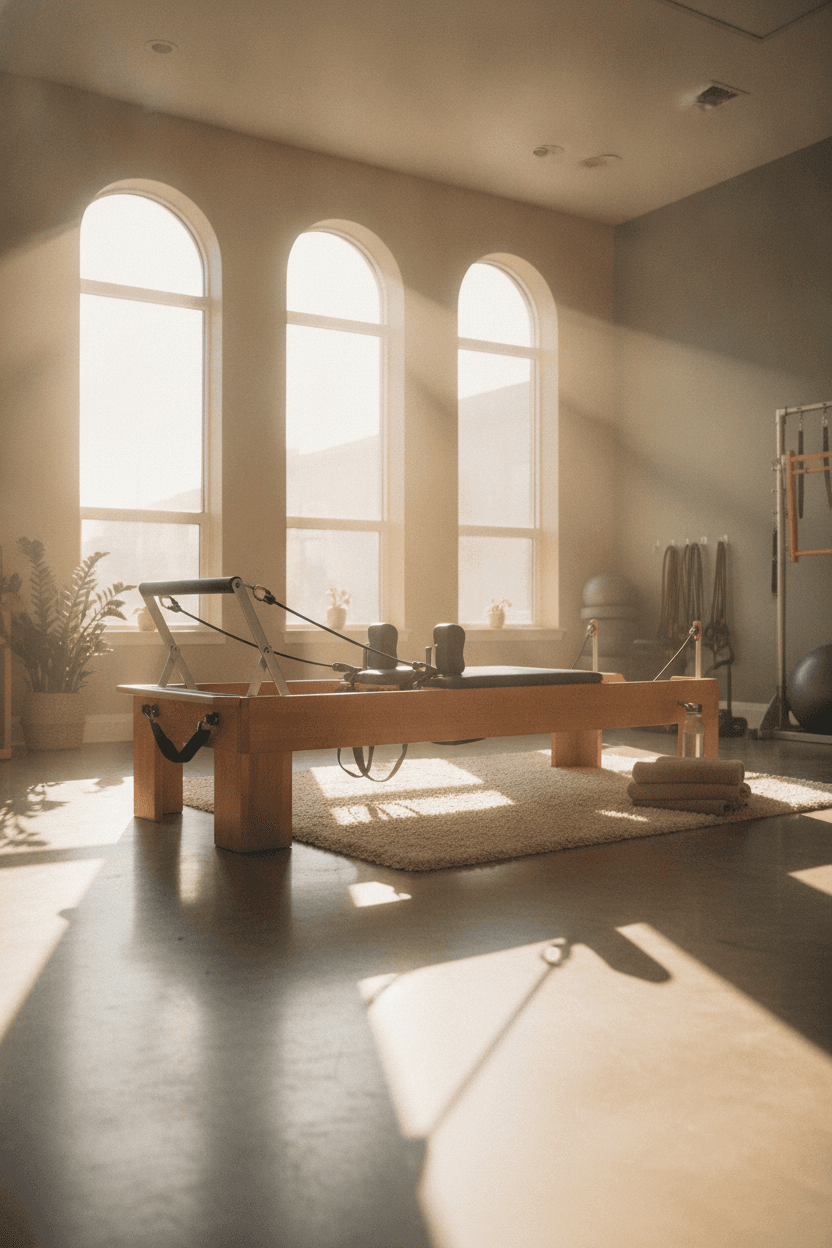
The cortisol awakening response (CAR) — a natural spike in cortisol in the first 30–45 minutes after waking — prepares the body and mind for the demands of the day. Moderate exercise during this window has been shown to amplify and then normalise the CAR, producing better cortisol regulation throughout the day. This translates to improved focus, more stable energy, and reduced afternoon fatigue.
Pilates is particularly well-suited to morning practice because it begins with neuromuscular activation rather than high-intensity loading. The attention and precision required in Pilates exercises engages the prefrontal cortex in a way that functional training and cardio at the same intensity do not — which may explain why many Pilates practitioners report that morning sessions have a pronounced effect on cognitive clarity throughout the day.
One adjustment is necessary for morning practice: the intervertebral discs rehydrate during sleep, increasing their height and temporarily making the spine less flexible. This is why forward bending feels stiffer first thing in the morning. Begin your morning routine with extension and gentle mobilisation rather than loading the spine into flexion immediately.
Suitable for all levels. Requires only a mat. The goal: neurological activation and postural muscle wake-up in the minimum viable time.
10 Minutes · Mat Only · All Levels
The most practical morning Pilates session for most people — a genuine workout in a realistic time frame. Requires a mat and optionally a foam roller.
20 Minutes · Mat + Foam Roller · Beginner–Intermediate
A complete mat Pilates session that covers the essential exercises from the classical repertoire — appropriate for practitioners with 4+ weeks of experience. Requires mat, optionally a Pilates ball and resistance band.
30 Minutes · Mat + Props · Intermediate
Warm-up (5 min)
Core and spine (10 min)
Hip and lateral chain (8 min)
Standing and integration (5 min)
Cool-down (2 min)
Non-slip Pilates mat (6mm)
The only essential — choose grip over thickness for morning floor work
Shop on Amazon →
Full-length foam roller (90cm)
Thoracic extension and spinal decompression first thing in the morning
Shop on Amazon →
Pilates ball (25cm)
Inner thigh, pelvic floor, and core activation across all three routines
Shop on Amazon →
Fabric resistance band (light–medium)
Progressive resistance for glute and hip work without a reformer
Shop on Amazon →
*Affiliate links — we earn a small commission on qualifying purchases at no extra cost to you.
Is it good to do Pilates first thing in the morning?
Yes — morning Pilates is beneficial for most people. Cortisol naturally peaks in the morning (the cortisol awakening response), and moderate exercise at this time has been shown to improve cortisol regulation throughout the day. The body is typically slightly stiffer in the morning due to overnight disc rehydration and reduced body temperature, so a gentle warm-up and lower-intensity work in the first 10 minutes is more appropriate than jumping straight into challenging exercises.
Should I eat before morning Pilates?
For sessions under 30 minutes at moderate intensity, most people perform well fasted. A small amount of easily digestible food — a banana or a few dates — is helpful if you feel lightheaded or if your session is 45+ minutes or high intensity. Avoid large meals within 90 minutes of Pilates practice, as full digestion and deep core engagement are physiologically incompatible.
How long should a morning Pilates routine be?
10 minutes is the effective minimum for meaningful neural and muscular activation in the morning. 20 minutes covers a proper warm-up, targeted work, and cool-down. 30 minutes is a full session that delivers the full benefits of Pilates practice. The research on morning exercise shows that consistency matters more than duration — 10 minutes every morning produces better outcomes than 30 minutes twice a week.
What equipment do I need for a morning Pilates routine at home?
A non-slip mat is the only true essential. A foam roller adds significant value for morning thoracic release — the back is often stiff first thing. A small Pilates ball and a resistance band cover the full range of morning routine exercises. All three pieces of equipment together cost under £50 on Amazon.
Equipment
A mat you leave unrolled the night before removes the friction of morning practice. The quality makes the routine feel like a considered ritual rather than a chore — relevant when willpower is lowest.
Shop on AmazonThe ideal morning Pilates opener. Two minutes of thoracic extension on a full-length roller wakes the spine and nervous system more effectively than stretching alone.
Shop on AmazonLight resistance band work in the morning activates the postural muscles before a day of desk work. 10 minutes provides more lasting postural benefit than the same time spent stretching.
Shop on AmazonRequires no space to set up and adds meaningful resistance to the morning core and hip work that makes reformer Pilates results replicable at home.
Shop on AmazonUsed in breathing and proprioception exercises at the start of the morning routine. The ball's tactile feedback helps establish body awareness before the more demanding exercises.
Shop on AmazonResearch-backed frequency recommendations for beginners, regulars, and advanced practitioners.
Read → 7 min readRealistic timelines — when you will feel, see, and sustain the changes from Pilates practice.
Read → 10 min readUse our curated city guides to find the best Pilates studios worldwide.
Explore City Guides →