EquipmentJune 2026
Best Pilates Reformer for Small Spaces
Foldable, compact and wall-storable machines ranked on footprint and full-workout capability.
Read → 11 min read
Updated September 2026 · 11 min read
The frame dimensions are the easy part and they are not what decides whether a reformer works in your room. What decides it is the clearance at each end, the ceiling height if you ever want tower work, and whether the machine can physically get from your front door to the room. Those three are the ones people measure after ordering. Here is how to measure them before.
The number you actually need
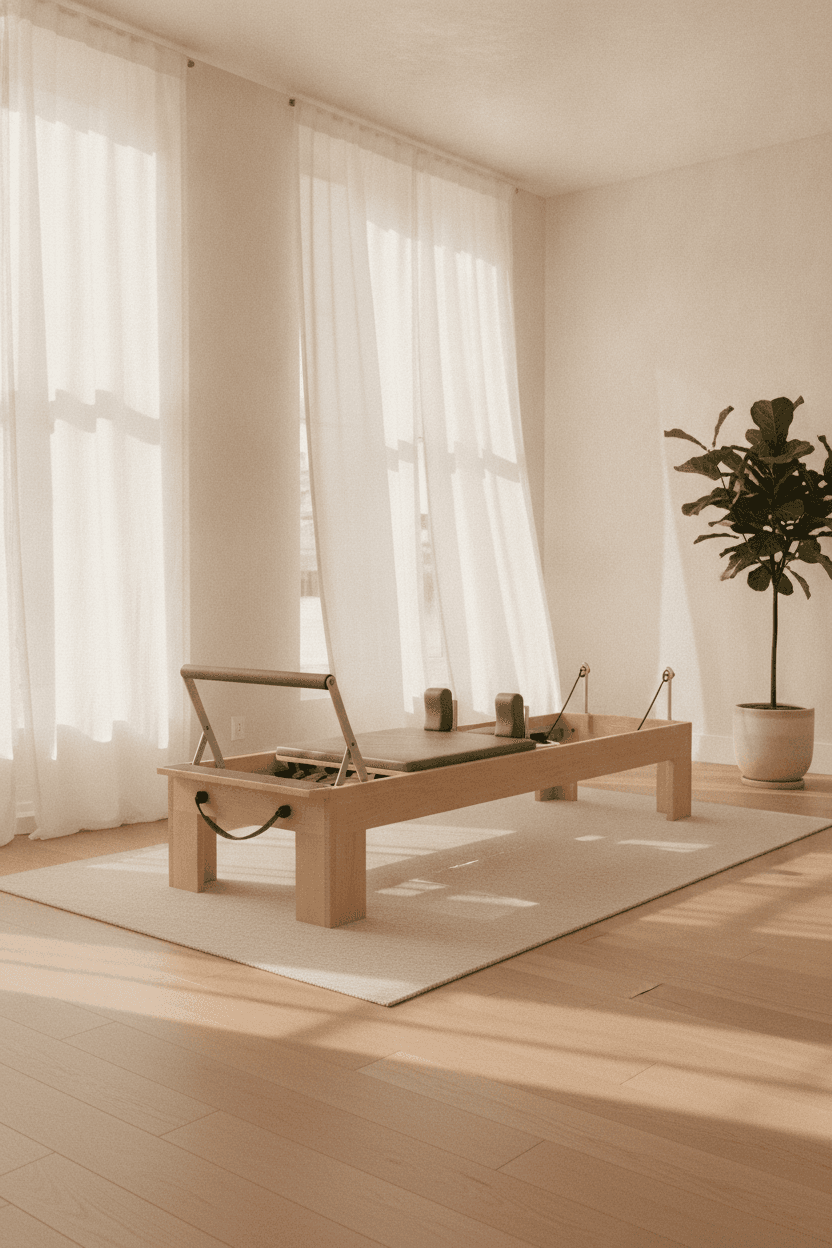
Take the machine footprint, add two to three feet at each end, and add a working side of at least two feet if anyone will ever teach or spot you. For a standard reformer at roughly 90 by 26 inches, that lands at about 12 to 13 feet of length and 4 to 5 feet of width, or somewhere around 50 to 65 square feet.
The end clearance is not optional padding. Several exercises extend the body past the frame, the footbar end needs room for a teacher to stand, and you have to be able to get on and off safely. A compact machine shortens the frame; it does not shorten the clearance.
Exact dimensions vary between models and between production runs, so treat these as the shape of each category and confirm the figures on the spec sheet for the specific machine you are buying. The class differences below are larger and more decisive than the variation within a class.
Standard studio reformer
~90 x 26 in operational
The full-size machine you meet in a studio, and the reference point the whole repertoire is written around. Full carriage travel and a multi-position footbar. Arrives substantially assembled, is heavy, and is not intended to be moved between sessions. If you want what you use in class, this is the class of machine, and the length is the thing to design your room around.
Compact full-function reformer
~88 x 24 in operational
Shorter and narrower than a studio machine while keeping a spring-based system and usable carriage travel. The Merrithew At Home SPX is the clearest example: shorter and narrower than the SPX Max, with the same spring system and carriage build. Fits along a wall in most bedrooms and living rooms. The saving is real but modest, so do not expect it to solve a room that is short by three feet.
Folding reformer
Folds to ~40 to 60% of footprint
Built for the storage problem specifically. Operational dimensions are close to a compact machine, but the frame folds for vertical storage against a wall, which is what makes it viable in an apartment where nothing can stay set up. Confirm both dimensions before buying, because the operational and folded figures are different numbers and listings sometimes lead with the flattering one.
Mini and portable reformer
From ~72 x 22 in operational
The smallest category, and the honest trade-off is carriage travel. Shorter travel changes how footwork and long-spine work feel, and taller practitioners notice it most. Genuinely useful where space is the absolute constraint or where the machine must be packed away entirely, but it is a different training experience rather than a smaller version of the same one.
Reformer with tower or half-trapeze
Footprint as standard, plus height
Adds a vertical frame at the footbar end for spring work from above, covering a good part of the cadillac repertoire in a reformer footprint. Floor area barely changes. Ceiling height becomes the binding constraint instead, and it is the one dimension you cannot design around later. Measure before ordering.
For a reformer on its own, ceiling height is rarely a problem. The carriage sits low and the overwhelming majority of the repertoire happens lying, seated or kneeling, so a standard eight-foot ceiling is fine.
It becomes the binding constraint in two situations. The first is standing work: the carriage platform is already raised off the floor, so a standing practitioner begins roughly a foot higher than they would on the ground, and arms overhead from there eat a surprising amount of room. The second is any tower, half-trapeze or cadillac attachment, where the vertical frame extends well above the carriage and the springs need travel above that.
The reason to settle this first is that it is the only dimension you cannot work around after the fact. A room that is a foot too short can take a compact machine. A room with a low ceiling permanently removes the tower repertoire from what you can do there, and no purchase decision later recovers it. Measure the real height, in the spot the machine will stand, and check it against the assembled height of the specific model. If you are fitting out a studio, our guide to opening a studio treats this as a pre-lease question for exactly this reason.
This is where deliveries fail, and it is almost never the doorway width. A studio reformer arrives substantially assembled: long, rigid and unable to bend around a corner. Measure all of the following, write them down, and give them to the supplier before you order.
Every turn on the route
The real constraint is diagonal clearance at a corridor-to-room turn, not the width of either. A 90-inch rigid frame needs meaningful diagonal space to pivot. Walk the route with a tape and measure the tightest turn, not the average one.
Lift internal depth, not just the door
A lift with a wide door and a shallow car will not take a full-size reformer. Measure the internal depth and the diagonal, and check the stated load capacity while you are there.
Stairwell width and landing turns
Stairs are usually survivable; the half-landing turn is what stops the delivery. If the route involves stairs, measure the landing and consider whether a flat-packed model is the better answer for that building.
Whether delivery includes getting it into the room
Confirm in writing. Kerbside delivery of a reformer leaves you with a very heavy object on the pavement and no obvious next step. For a studio order, ask whether assembly and calibration are included and who performs them.
Whether a flat-packed model solves it
Home and compact reformers frequently ship flat-packed and assemble in the room, which removes this whole category of problem. In an upper-floor apartment with tight turns, that is a legitimate reason to choose the class of machine, quite separately from price.
Two honest options, and one thing not to do. The first option is a folding machine: operational dimensions close to a compact reformer, folding to somewhere between 40 and 60 percent of that for vertical storage against a wall. This is the category built for the problem, and if the machine cannot stay set up, it is the answer. See our roundups of foldable reformers and reformers for small spaces.
The second is to accept a mini or portable machine and its shorter carriage travel. That is a real change to how footwork and long-spine work feel rather than a cosmetic one, and taller practitioners notice it most, but a machine you use in a room that fits beats a machine you admire in a room that does not.
What not to do is buy a full-size machine on the assumption that you will shuffle it into position for each session. Reformers are heavy, dragging them damages floors, and the friction of setting up is the single most reliable predictor of a reformer that stops being used. If it cannot live where you will use it, either fold it properly or buy the class of machine that can.
How much space do I need for a Pilates reformer?
A standard reformer occupies approximately 90 by 26 inches of floor space in its operational position. On top of that you need two to three feet clear at each end, for getting on and off, for the footbar end, and because several exercises extend past the frame. Add a working side of at least two feet if anyone will ever teach or spot you. That puts the practical requirement at around 12 to 13 feet of length and 4 to 5 feet of width, or roughly 50 to 65 square feet. Compact and folding models reduce the frame itself to as little as 72 by 22 inches, but they do not reduce the clearance you need at the ends.
What ceiling height do you need for a Pilates reformer?
For a reformer alone, a standard eight-foot ceiling is fine, because the carriage sits low and almost all of the repertoire is performed lying, seated or kneeling. The constraint appears when you add a tower or trapeze unit, or if you want standing work on the footbar. The carriage platform is already raised off the floor, so a standing practitioner starts roughly a foot higher than they would on the floor, and a tower frame extends well above that. If tower work matters to you, measure your actual ceiling height and check it against the specific model's assembled height before ordering, because this is not something you can work around afterwards.
Can a Pilates reformer fit in a bedroom or apartment?
Often yes, and the binding constraint is usually length rather than area. A standard reformer at around 90 inches is longer than most beds, so the realistic placement is along a wall, which means the room needs roughly 12 feet in one direction once you count end clearance. Where that does not work, folding and compact models are the category built for the problem: some reduce to around 60 percent of their operational footprint and store vertically against a wall. The trade-off is carriage travel, which changes how some exercises feel.
Will a reformer fit through my door?
This is the question that catches people out, and it has nothing to do with the room. Studio reformers arrive substantially assembled and are long and rigid, so the limiting factor is rarely the doorway width but the turn from a corridor into a room, the stairwell, or the lift depth. Measure the doorway width, the corridor width, every turn on the route, and the lift internal depth, then give those numbers to the supplier before ordering and ask them to confirm in writing. Flat-packed home models sidestep this entirely, which is a real advantage in an upper-floor apartment.
Reformers
One machine from each class above, from the full studio frame down to the compact and cord-resistance options. Check the warranty covers your intended use before ordering, and confirm the machine fits the room and the route into it.
The permanent-installation machine that populates certification centres and clinics. Strata rock maple frame, five signature springs, and full tower compatibility. Price runs $4,400 to $4,800 depending on which of the four footbars you choose. It does not fold.
Shop on AmazonThe STOTT PILATES reference machine, and the one that folds completely flat onto castors to roll under a bed. Five colour-coded springs with unusually fine gradation at the light end, which is what makes it the pick for rehabilitation and prenatal work.
Shop on AmazonShorter and narrower than the SPX Max while keeping the same spring system and carriage build. Fits along a wall in most bedrooms. Sold mainly as a package, so confirm what a given price includes.
Shop on AmazonThe cheapest genuine spring reformer from a major brand, and the machine that marks the real floor of the category. Short stored length makes it the one that fits where a full studio frame does not.
Shop on AmazonThe one machine from a recognised brand that genuinely costs under $2,000. It uses elastic cord rather than coil springs, which is a real difference in how resistance builds, but for building a habit it is a workable trade.
Shop on AmazonEquipment
None of these change the dimensions of your room. What they do is make a machine in a shared space practical to store, safe to move, and less damaging to the floor it stands on. Check weight ratings and model compatibility before ordering.
For a folding reformer, a wall bracket is what turns the folded position from an awkward lean into actual storage. It holds the frame stable and vertical, keeps it off the skirting, and removes the main reason people stop folding it and leave it up permanently. Check the weight rating against your machine before buying.
Shop on AmazonA full-size reformer is heavy and dragging it across a floor damages both. Sliders under the feet let one person reposition a machine for cleaning or for a class layout change without lifting. The cheapest thing on this list and the one that saves a floor.
Shop on AmazonWorth the twenty minutes before a four-figure order. A laser measure gets you accurate ceiling height, doorway widths and corridor turns faster and more reliably than a tape you are holding above your head, and ceiling height is the measurement people guess at and then regret guessing at.
Shop on AmazonA reformer concentrates a lot of weight on four small feet, which dents timber and compresses carpet permanently. A mat under the frame spreads the load, protects a rented floor, and noticeably cuts the carriage noise transmitted into the room below, which matters in an apartment.
Shop on AmazonIf the machine lives in a living space rather than a dedicated room, a fitted cover keeps dust off the upholstery and the springs and makes the thing read as furniture rather than gym equipment. That sounds cosmetic and it is the reason some people keep a reformer at home rather than selling it.
Shop on AmazonFoldable, compact and wall-storable machines ranked on footprint and full-workout capability.
Read → 11 min readThe folding machines that actually fold, and what the mechanism costs you in carriage feel.
Read → 10 min readFrame, weight rating, warranty and duty cycle: what separates the two tiers.
Read → 11 min readCarriage travel and footbar height are what decide fit above six feet.
Read → 10 min readUse our curated city guides to find the best Pilates studios worldwide.
Explore City Guides →