BeginnersMay 2026
Beginner's Guide to Reformer Pilates
What to expect from your first reformer class and how to prepare.
Read → 8 min read
Updated May 2026 · 10 min read
The most common question from people new to Pilates is also one of the most misunderstood: what exactly is the difference between reformer and mat? The short answer is that they share the same principles and movement language, but deliver a completely different physical experience. This guide explains what each format actually involves, who benefits most from each, and how serious practitioners typically approach both.
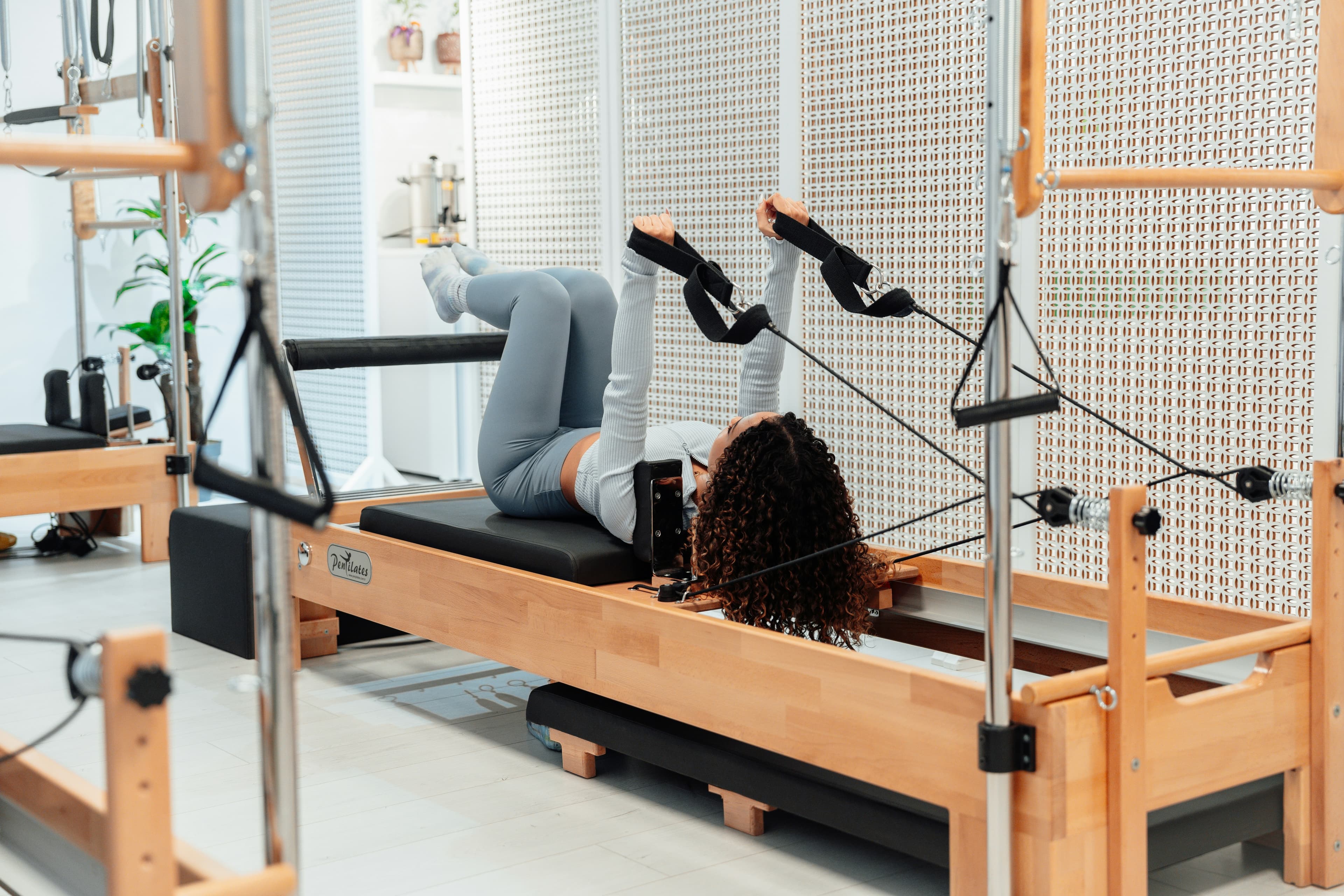
The reformer is a spring-resistance machine consisting of a rolling carriage, a stationary footbar, shoulder blocks, and a set of adjustable springs. You perform exercises by pushing or pulling the carriage against spring tension — lying, sitting, kneeling, or standing on the carriage itself, or standing beside it using the straps attached to the front pulley.
What makes the reformer distinctive is that the spring resistance can be both assistive and resistive within the same exercise. A stiff spring makes an exercise harder. A lighter spring can make certain movements easier — allowing practitioners to find correct form before adding challenge. This bidirectional resistance is what makes the reformer so effective for rehabilitation as well as performance.
Reformer classes are typically conducted in groups of 6–12 in modern boutique studios, with each participant on their own machine. The instructor cues verbally and moves between machines to provide hands-on corrections. Sessions run 50–55 minutes.
Mat Pilates is what Joseph Pilates originally called Contrology — the 34-exercise sequence he developed and taught from the 1920s onward. All you need is a mat and your own body. The resistance comes entirely from gravity and your own muscular effort, which means there is no spring assistance available. In this sense, classical mat work is arguably harder than reformer work — particularly for intermediate and advanced exercises where the reformer's springs can assist.
Mat classes vary enormously in quality and intensity. A classical mat sequence follows the original order and progresses systematically through the 34 exercises. Contemporary mat classes may incorporate props — resistance bands, small balls, foam rollers, or the Pilates ring — to add variety and modify intensity.
Mat Pilates is substantially more accessible than reformer work in terms of cost and location. A quality mat is all the equipment required, and there is a significant amount of excellent online instruction available for home practice.
Cost
Mat: $15–30 per class or subscription-based online. Reformer: $30–60+ per class at boutique studios. Home reformers range from $500 to $8,000+.
Accessibility
Mat classes are available everywhere from community centres to luxury studios to living rooms. Reformer requires a studio with equipment or a significant home investment.
Difficulty
Neither is inherently harder. Reformer can be modified more easily for beginners using spring assistance. Classical mat is demanding even for experienced practitioners.
Instructor feedback
Both formats allow for good instruction. Reformer classes are typically smaller and allow more individual cueing. Large mat classes can be less personalised.
Rehabilitation suitability
Reformer is preferred for injury rehabilitation due to the spring's assistive/resistive versatility. Mat is appropriate for many conditions but less adaptable.
Results for body composition
Both methods produce comparable results when practised consistently. The reformer's resistance can be progressed more systematically, which some practitioners find more motivating.
Virtually every serious Pilates practitioner will tell you the same thing: the two formats are complementary, not competing. The reformer develops the method in ways that mat cannot; mat develops body mastery that reformer work doesn't fully address. The classical Pilates system assumes you practise both — the full apparatus work (which includes the reformer) alongside the mat sequence.
If you're choosing one to start, reformer classes at a quality studio give you faster initial feedback and more instructor contact. Once you have the foundation, adding mat work — whether in class or at home — deepens your practice in a different dimension.
Which is better for weight loss: reformer or mat?
Neither format is primarily a weight-loss tool. Pilates builds strength, improves posture, and develops body awareness. Both formats contribute to body composition change when practised consistently alongside appropriate nutrition. The reformer's spring resistance allows more progressive overload over time, which can be advantageous for body composition goals.
Can a complete beginner start with reformer?
Yes — reformer classes designed for beginners are the most common entry point for new practitioners at boutique studios. The spring assistance actually makes certain exercises more accessible than on a mat. Look for explicitly labelled 'Intro' or 'Fundamentals' reformer classes.
Is mat Pilates useful if I already do reformer?
Absolutely. Many of the reformer exercises originated as mat exercises, and practising both reveals gaps in your body that the apparatus may have been compensating for. Serious practitioners and instructors consistently recommend regular mat practice regardless of reformer experience level.
What equipment do I need to practice mat Pilates at home?
A firm mat is the minimum requirement — a dedicated Pilates mat (slightly thicker and less grippy than a yoga mat) is preferable. Resistance bands and a Pilates ring can add significant variety and progressive challenge to a home mat practice without a large investment.
Equipment
The foundation of the mat system — Joseph Pilates' 34 exercises require only a mat. If you are choosing between mat and reformer practice, a high-quality mat is the essential starting point.
Shop on AmazonIf budget and space allow, a home reformer transforms what is achievable in independent practice. Entry-level machines from AeroPilates and Merrithew start the reformer system at accessible price points.
Shop on AmazonBridges mat and reformer practice — provides the lateral resistance that the reformer springs offer, making it the best single tool for bringing reformer benefits to mat sessions.
Shop on AmazonResistance bands provide spring-like resistance for mat practice. Not a substitute for the reformer, but a meaningful upgrade to mat-only home practice that approximates some of what the springs add.
Shop on AmazonAdds the spinal articulation and thoracic mobility work that the reformer supports through its spring system. A core tool for anyone whose practice is primarily mat-based.
Shop on AmazonWhat to expect from your first reformer class and how to prepare.
Read → 8 min readA quality home reformer changes your practice permanently. Every price tier reviewed.
Read → 11 min readMat, ring, bands, roller, and reformers — the complete home Pilates equipment list ranked by value.
Read → 10 min readUse our curated city guides to find the best Pilates studios worldwide.
Explore City Guides →