Equipment GuideMay 2026
Best Pilates Leggings (2026)
The five best leggings for Pilates studio-tested across reformer, mat, and tower — ranked by opacity, waistband stability, and overall value.
Read → 9 min read
Updated May 2026 · 10 min read
Affiliate disclosure: Some links on this page go to Amazon. We earn a small commission on qualifying purchases at no extra cost to you. This does not affect our editorial judgement — we compare both products honestly.
This comparison is written for practitioners who already know they want to invest in a premium studio legging and are deciding between the two most-discussed options in Pilates circles. We tested both across reformer, mat, and tower sessions — specifically examining the criteria that matter in a Pilates context, where your instructor observes alignment closely and the equipment places unusual demands on fabric. Here is what we actually found.
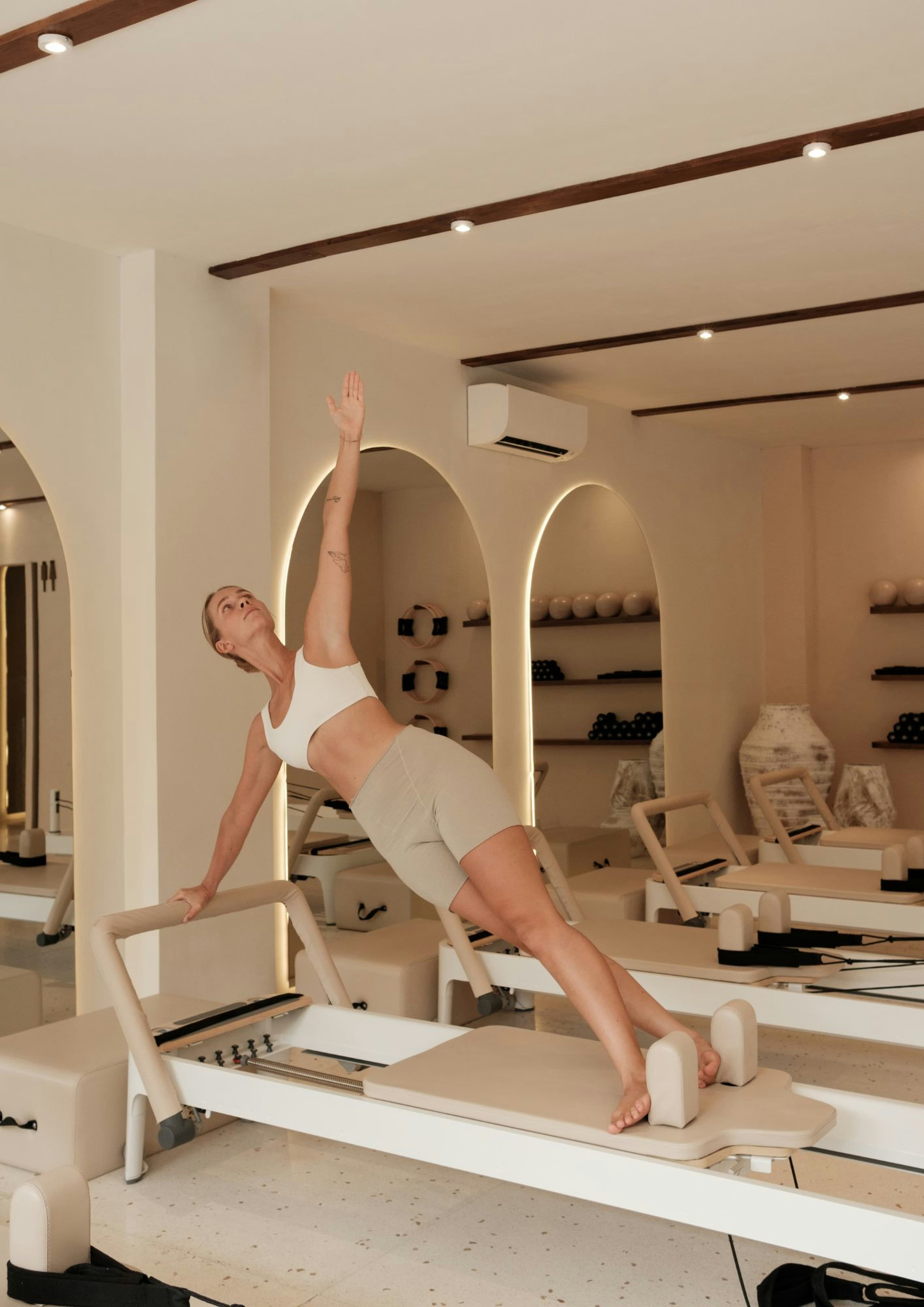
Quick Verdict
Lululemon Align
Best for
Alo Airbrush
Best for
Our Overall Pick
For most Pilates practitioners — especially those attending reformer classes regularly — the Alo Airbrush edges ahead. Its durability advantage, consistent opacity, and more stable waistband under reformer-specific movement patterns make it a more practical long-term choice. The Align remains exceptional, particularly for mat-focused practitioners, but its pilling tendency and fabric sensitivity in lighter shades are genuine limitations for studio use.
Each criterion tested specifically within a Pilates context.
Criterion 01
Align — Nulu
Nulu is a proprietary Lululemon blend — predominantly nylon with elastane — weighing approximately 150–160 g/m². The sensation is genuinely exceptional: ultra-soft, warm against skin, with almost no perceived weight. On the body it reads as nothing at all.
Airbrush — Airlift
Alo's Airlift fabric is a denser, slightly heavier blend — around 200–220 g/m² — with a matte, polished finish. It has a smooth, almost slick feel that reads as "premium" in a different register: structured and sleek rather than pillow-soft.
These are not competing versions of the same sensation — they are categorically different. The Nulu fabric in the Align is arguably the softest activewear fabric currently produced at scale. If you have ever put on the Align and immediately understood why people pay $128 for leggings, it is because of Nulu. The Airlift fabric in the Airbrush offers a very different pleasure: cool, structured, and body-sculpting rather than cocooning. Neither is objectively superior. They suit different sensory preferences entirely.
Edge: Align (for softness) · Airbrush (for structured feel)
Criterion 02
The Lululemon Align is intentionally low-compression. Lululemon designed the Align for yoga and movement practices where maximum sensory freedom outweighs support. The fabric hugs without squeezing — there is no inward pressure on the legs or abdomen. For Pilates, this has a specific implication: during the hundred, roll-ups, or teaser variations where abdominal engagement is the whole point, the Align does not add any external pressure that could mask or substitute for genuine core effort.
The Alo Airbrush delivers medium-to-firm compression. The Airlift fabric actively holds the silhouette — you feel it working. During reformer footwork (lying supine, legs pressing and extending at 90 degrees of hip flexion repeatedly), the Airbrush maintains a smooth, contained line in a way the Align does not. Some practitioners actively value this as proprioceptive feedback; it sharpens body awareness during leg work. Others find it subtly restrictive for floor-based exercises that require lateral rotation of the hip.
There is no right answer here — it depends on whether you want your leggings to participate in your practice or stay out of the way. Instructors generally do not have a preference either way.
Edge: Airbrush (for reformer support) · Align (for mat freedom)
Criterion 03
Opacity matters more in Pilates than in nearly any other movement practice. Reformer footwork requires sustained deep hip flexion — legs pressed to the footbar, pelvis in neutral, hips at 90 degrees or beyond. Leg circles, frog position, and long-spine massage all create positions where fabric is stretched to its limit. Any sheerness present at rest will be compounded dramatically in these positions.
The Align in black is completely opaque under all testing conditions. However, lighter colourways — ivory, soft blush, pale stone, and pastel tones — show measurable sheerness in deep hip flexion. This is a consequence of Nulu's lower fabric weight and the way it stretches: the weave opens under tension. Lululemon's own squat-test marketing focuses on squatting, but the Pilates hip-flexion position is a more extreme fabric stress test than a bodyweight squat.
The Alo Airbrush is fully opaque across all colourways including white and light neutrals. The denser Airlift fabric does not open under stretch in the same way. For practitioners who love lighter colourways, the Airbrush is the only safe choice. For darker Align shades, opacity is not a concern.
Edge: Airbrush (decisive advantage, all colourways)
Criterion 04
Pilates movement vocabulary puts waistbands through a specific stress sequence that differs from running or HIIT. The hundred involves sustained core contraction in a semi-supine position with repeated arm pumps — abdominal pressure from within pushes outward against the waistband. Roll-ups and rolling like a ball require the waistband to accommodate the spine rounding through it. Side-lying leg series pulls the waistband laterally. These forces combined are a more thorough test than any squat.
The Align's wide, smooth waistband performs very well here. It does not roll, does not dig, and sits flat whether you are lying on your back, side, or stomach. The band is seamless at the body-contact edge, which matters when performing exercises lying prone on the reformer carriage. In our testing, it held its position across a full 55-minute reformer session without any adjustment.
The Airbrush waistband is similarly wide and high-rise, but with slightly more structure thanks to the denser Airlift fabric. It holds its position with even more authority — there is genuinely no movement. In the prone position on a reformer carriage, the stiffer waistband can create a slight pressure point for some practitioners; the softer Align band does not. Both waistbands perform excellently, but the Align edges ahead marginally for practitioners who do significant prone work.
Edge: Tie — both excellent, slight Align edge for prone work
Criterion 05
$98–128
Lululemon Align
$88–118
Alo Airbrush
The Alo Airbrush typically comes in slightly under the Align on retail price, though both sit within striking distance of each other. The more meaningful value comparison is cost-per-wear over time. The Align's Nulu fabric pills at the inner thigh noticeably faster than the Airbrush's Airlift. For a practitioner attending four sessions per week, Align leggings typically need replacing at around 12–18 months of regular use. Airbrush leggings, in our experience, hold their surface integrity for closer to 24 months with equivalent use. On a pure cost-per-wear calculation, the Airbrush represents better value despite similar price points.
Edge: Airbrush (better long-term cost-per-wear)
Criterion 06
Lululemon offers the Align in sizes 0–20 (US), with a dedicated Align Tall line extending inseams to 31 inches. Standard inseam options are 21 inches (crop), 25 inches (7/8), and 28 inches (full), with some colourways also available in 31 inches. For Pilates specifically, the 25-inch or 28-inch inseam is the most practical: instructors can observe knee alignment clearly, and the length prevents the legging from riding up during leg-circle or spring-resistance footwork.
The Alo Airbrush is available in XS–XL with less comprehensive size inclusivity at the upper end. Inseam options are more limited — typically 25 and 28 inches. The Airbrush runs true to size but the firmer compression means sizing up may be advisable at the waistband for practitioners between sizes. For petite or tall practitioners, Lululemon's superior size and inseam range is a genuine advantage.
Edge: Align (superior size range and inseam options)
Criterion 07
The Nulu fabric in the Align is the weakest point of an otherwise excellent product. It pills. Not catastrophically, not immediately, but noticeably — beginning at the inner thigh after consistent weekly use, progressing to the seat and outer thigh. The pilling is partly a consequence of what makes Nulu exceptional: the low-friction, ultra-soft weave that creates that pillow sensation also pills more readily when rubbed against itself or reformer carriage surfaces repeatedly. Both Lululemon and independent reviewers widely acknowledge this limitation.
The Alo Airbrush holds up significantly better. The denser Airlift fabric resists pilling, colour holds through repeated cold washing, and the waistband elasticity remains consistent beyond 100 wash cycles. Both leggings should be washed inside-out on cold and air-dried — tumble drying accelerates the degradation of elastane in any performance fabric. Fabric softener should be avoided: it coats the moisture-wicking fibres and reduces both breathability and compression recovery over time.
Edge: Airbrush (significantly more resistant to pilling)
Criterion 08
Both brands have made public commitments to sustainability — and both have been challenged on the gap between stated goals and operational reality. Lululemon has a Be Planet initiative targeting net-zero by 2050 and has introduced some recycled materials into select products, but the Align leggings are not yet made from recycled fibres. The brand has faced scrutiny over supply chain transparency.
Alo Yoga has similarly positioned itself as a wellness and sustainability brand while relying predominantly on virgin synthetics. Neither brand is a model of circular production. The honest answer for sustainability-conscious practitioners: both brands are in the middle of the field, not at the front. If environmental credentials are a primary purchase criterion, brands like Girlfriend Collective or Patagonia are more credibly positioned. For most Pilates practitioners, the sustainability difference between Align and Airbrush is not a meaningful deciding factor — they are broadly equivalent on this dimension.
Edge: Tie — broadly equivalent sustainability positioning
Buy the Lululemon Align if —
You practise primarily mat-based Pilates, barre, or yoga — or any format where freedom of movement and sensory minimalism are the priority. The Align is also the right choice if you are sensitive to compression or find firmer fabrics distracting during core-focused exercises. For practitioners who do not pile through inner-thigh fabric quickly (lighter body weight, lower activity frequency), the pilling concern is less pressing. If sizing inclusivity or a wide range of inseam options matters to you, Lululemon's range is also substantially more accommodating. Choose dark colourways for reformer classes specifically.
Buy the Alo Airbrush if —
You attend reformer classes multiple times per week and want a legging that holds up to that frequency without pilling or losing shape. The Airbrush is also the only choice if you want to wear white or light-coloured leggings to class safely. Its consistent opacity across all colourways is a genuine functional advantage over the Align. The compression level suits practitioners who find proprioceptive feedback through their clothing helpful — and the sculpting effect is appreciated by many who want to feel put-together in a boutique studio environment without sacrificing function.
Consider a different option if —
Neither of these leggings is the right answer for every practitioner. If you run hot in studio environments, both Nulu and Airlift trap warmth — Vuori or a lighter-weight fabric will serve you better. If you are building your Pilates wardrobe for the first time and are not yet sure how committed you will be, the CRZ YOGA Naked Feeling legging offers remarkable value at a third of the price of either option. And if sustainability is a primary criterion, Girlfriend Collective or Patagonia offer more credible environmental stories than either Lululemon or Alo at this time.
Is the Lululemon Align or Alo Airbrush better for reformer Pilates?
Both perform well on the reformer, but they suit different preferences. The Align excels for practitioners who want freedom of movement and a barely-there sensation during hip flexion and leg circles. The Airbrush is better for those who prefer a firmer, more supported feel — the medium-to-firm compression holds the silhouette during footwork and long-spine exercises in a way the Align does not. If compression is important to you, the Airbrush wins. If sensory freedom matters most, the Align is unmatched.
Which legging is more opaque — the Lululemon Align or Alo Airbrush?
The Alo Airbrush is consistently more opaque across all colourways and in positions of deep hip flexion. The Lululemon Align is fully opaque in black and darker shades but lighter colours — particularly whites, light pinks, and pale neutrals — can show sheerness during the deep forward fold required in reformer footwork. For Pilates specifically, darker Align colourways or the Airbrush in any colour are both safe choices.
Do the Lululemon Align leggings pill over time?
Yes, the Nulu fabric used in the Align is prone to pilling with regular use — typically appearing first at the inner thigh after three to six months of studio wear. This is a known and well-documented limitation of the fabric. The Alo Airbrush's Airlift fabric is significantly more resistant to pilling and holds its surface texture longer. If longevity matters, the Airbrush has a clear advantage.
Is the Alo Airbrush worth the price over cheaper alternatives?
For dedicated Pilates practitioners who attend multiple sessions per week, yes. The Airbrush's durability, consistent opacity, and waistband stability across hundreds of wash cycles justify the premium over budget alternatives. For casual practitioners or beginners still deciding whether Pilates will become a regular habit, a quality budget legging like the CRZ YOGA Naked Feeling is a sensible starting point.
The five best leggings for Pilates studio-tested across reformer, mat, and tower — ranked by opacity, waistband stability, and overall value.
Read → 9 min readThe complete guide to choosing the right clothes for studio and reformer classes — leggings, tops, layers, and why grip socks matter.
Read → 8 min readUse our curated city guides to find the best Pilates studios worldwide.
Explore City Guides →