Equipment GuideMay 2026
Best Home Pilates Reformer (2026)
The best home reformers at every price point — from entry-level to studio-grade.
Read → 10 min read
Updated May 2026 · 9 min read
*Some links on this page go to Amazon. We earn a small commission on qualifying purchases.
Most beginner reformer guides start with the machine. This one starts with an honest question: are you ready to buy? Buying a home reformer before you understand the machine is one of the most reliable ways to spend $300–$3,500 on something that collects dust — this guide tells you when to buy, what to buy, and which beginner mistake to avoid at every price point.
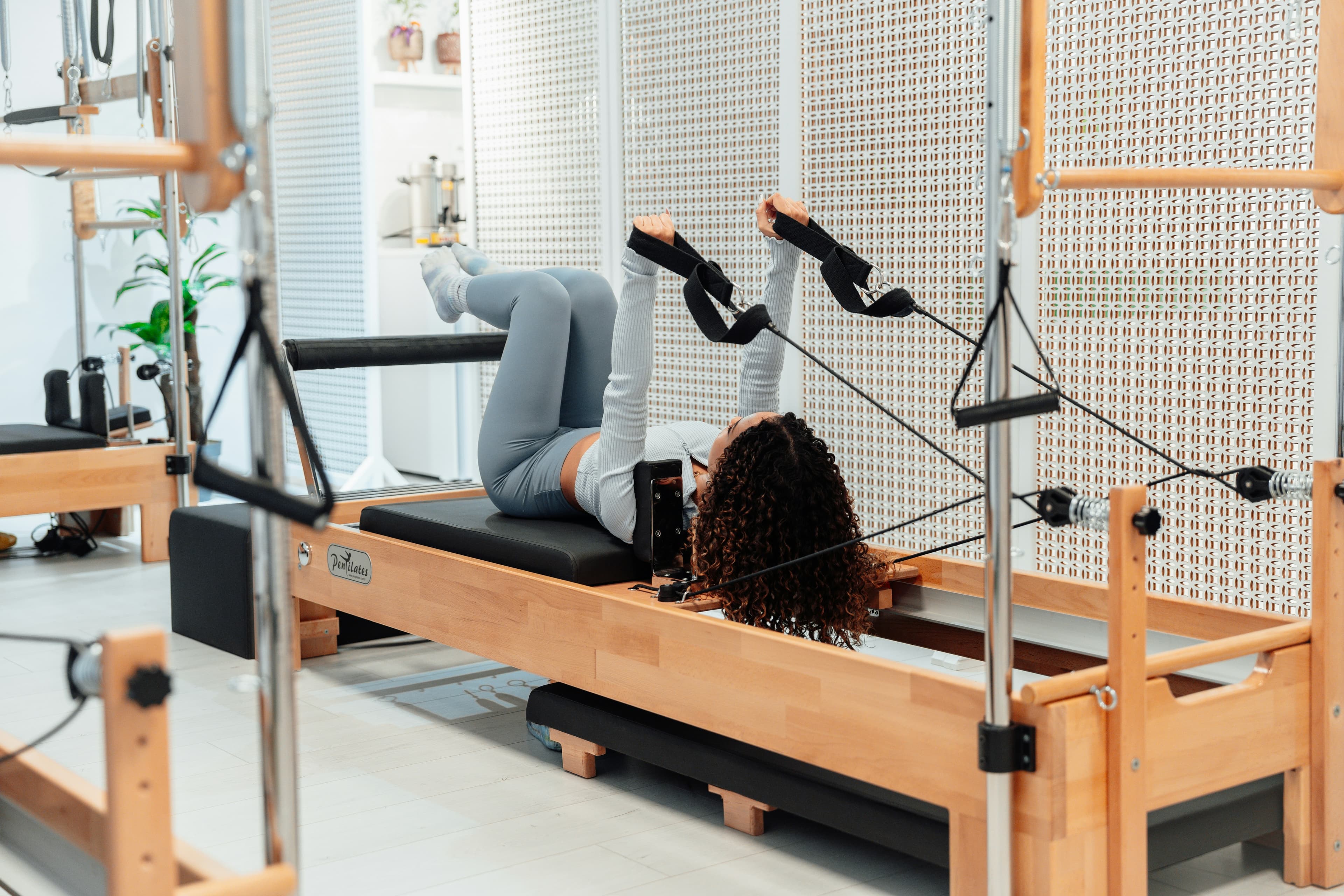
For most people, no. Reformer Pilates is technique-dependent in a way that yoga and most gym exercise is not. Without an understanding of neutral spine, scapular stability, and breath coordination, home practice on a reformer actively reinforces poor movement patterns. The machine amplifies both correct and incorrect mechanics — it doesn't discriminate. Take at least 6–10 studio sessions first. Those sessions give you the proprioceptive baseline that makes home practice genuinely productive rather than quietly counterproductive.
The exception: if you have a strong movement background — dance, gymnastics, yoga teacher training, or physiotherapy — and can access instructional content from a qualified teacher (live online sessions, or video with feedback), self-starting on a budget machine is workable. Movement literacy translates. You'll still have gaps specific to the reformer, but you have the foundational body awareness to recognise and correct them.
When you're ready: you know what footwork feels like (the sensation of the carriage pressing back from the footbar), you can set spring resistance yourself, and you have at least a 20-minute sequence you can perform with confidence. At that point, a home machine extends your practice. Before that point, it complicates it.
Instruction included
Does the machine come with guided workouts? AeroPilates machines ship with DVDs and have an online video library. This is valuable for beginners who need movement cues, not just equipment. A machine without instructional support assumes knowledge the beginner doesn't yet have.
Spring vs cord
Beginners coming from studio sessions should ideally match the resistance system they've trained on. Those who have trained on springs (most studios) will find cord machines feel different. Those who have never trained at all won't notice the difference — either system teaches the foundational movement patterns.
Adjustability range
Beginners need the widest spring or cord adjustment range because their strength and conditioning are still developing. Machines with only 2–3 resistance levels are limiting; 4–5 levels give room to grow through the foundational repertoire without outpacing the machine.
Support and service
Beginners encounter more mechanical questions and assembly challenges. Brands with responsive customer service (AeroPilates, Balanced Body, Merrithew) are worth the premium over unbranded alternatives with no support infrastructure. When something goes wrong at week two, you need someone to call.
6 Reformers for Beginners · Ranked by Starting Point
WINDFOOT Foldable Pilates Reformer w/ Jump Board
Cheapest genuine spring reformer — for a beginner who wants real springs, not cord
The AeroPilates Pro XP 557 is a reasonable recommendation for beginners who have had at least a few studio sessions and are ready to practice at home. It uses elastic cord resistance rather than coil springs — cord resistance is generally more forgiving and predictable for learners than spring resistance, which reduces the risk of uncontrolled movement during unfamiliar exercises. We could not verify specific claims about an included rebounder, fold-flat mechanism, or standing platform for this exact listing beyond what the current Amazon page shows — confirm what ships with it before ordering rather than assuming it matches other AeroPilates models. The cord system differs from spring reformers, but for a beginner learning positions and movement patterns, this difference is largely imperceptible.
Shop on AmazonFor an absolute beginner who wants to try reformer Pilates at home before committing to a studio or a higher investment machine, the AeroPilates 287 is the most accessible starting point among the real, currently-sold reformers we could verify. It uses elastic cord resistance. We could not confirm specific details like carriage material or included accessories beyond what the current listing shows, so check that directly. Buy the 287 as an exploration tool. If you practise on it for three months and the reformer has become central to your practice, consider upgrading to a coil-spring machine. If you practise twice and it becomes a clothes rack, you've spent $359 rather than several thousand.
Shop on AmazonA fresh check of the live Amazon catalog turned up a real tier of budget, generic-brand full reformers that an earlier pass on this guide missed. WINDFOOT is worth knowing about specifically for a beginner: it's a real, live, currently-sold Amazon listing at $295.99, sold by YIWU MUZHU, and unlike the AeroPilates 287 above, it's a genuine carriage-and-rail spring reformer rather than an elastic-cord machine — pre-assembled roughly 90% out of the box (a 5–10 minute setup), with a padded rebounder for cardio and a non-slip leather surface, and it folds for storage. It's a generic brand with no established track record, no instructor certification recognition, and unclear long-term durability or warranty support — a real trade-off against the AeroPilates 287's brand history at a similar price. For a beginner on a tight budget who specifically wants to learn on genuine spring resistance rather than cord, this is the honest low-cost option to know exists.
Shop on AmazonFor a beginner who has already done significant studio work (six months or more), knows the reformer is central to their practice, and wants to invest once correctly, the Merrithew At Home SPX Reformer Package is the premium recommendation — the real SPX-family machine Merrithew sells on Amazon, with a genuine coil-spring system similar to what they've trained on in STOTT PILATES studios. We could not verify a fold-flat storage feature for this listing — an earlier version of this guide made that claim in error — so don't assume it stores away. This is not a machine for someone who has never tried a reformer; it is for someone who knows they love the reformer and is ready to invest in doing it properly at home.
Shop on AmazonIf a beginner has dedicated floor space and a serious commitment to the practice, the Balanced Body Studio Reformer is the real Balanced Body flagship sold on Amazon and offers strong long-term value as a permanent-installation machine — it does not fold, and is made to order. The Strata rock maple frame, five Signature Springs, and full tower compatibility set a high standard for home equipment. What makes it appropriate for a beginner rather than a distraction: the machine grows with the practitioner — the same reformer supports beginner footwork and the most advanced classical exercises without ever feeling limiting. Buy this once and don't upgrade. The risk is the same as all premium first-machine purchases: it assumes the practice will stick. For practitioners with studio experience who are confident the reformer is for them, the risk is worth taking.
Shop on AmazonFor a beginner ready for a real coil-spring reformer but not yet committed to the Balanced Body or Merrithew investment, the Align-Pilates C8-PRO is a sensible middle ground — sold on Amazon by Merrithew, Align's US distributor. It's a genuine coil-spring machine with an adjustable footbar, at a real discount to anything comparable from Balanced Body or Merrithew. We could not verify specific claims about spring count, bearing type, or a folding mechanism beyond what the current listing shows, so check those details there before ordering. For a beginner who has trained in a studio, is confident in the practice, and wants real spring resistance without the higher-end outlay, the C8-PRO is a strong value recommendation.
Shop on AmazonHow many sessions do I need before buying a home reformer?
A minimum of 6–10 studio sessions. Ideally 3–6 months of regular practice. You need to know the foundational exercises (footwork, the hundred, rowing series) and how to set spring resistance before home practice is productive.
Is a budget cord-based reformer good enough for a beginner?
For exploring whether reformer Pilates is for you, yes. For building a serious practice, no — the limitations of a budget, elastic-cord machine become apparent within 2–3 months of regular use compared with a genuine coil-spring reformer.
Is the budget WINDFOOT reformer a real alternative to the AeroPilates 287 for a beginner?
It's a real, live, currently-sold Amazon listing at $295.99, and unlike the AeroPilates 287 it uses genuine spring resistance rather than elastic cord. But WINDFOOT is a generic brand with no established track record, no instructor certification recognition, and unclear long-term durability or warranty support, while AeroPilates is an established brand with a longer history. For a beginner on a tight budget who specifically wants to learn on real springs, WINDFOOT is worth knowing about; for a beginner who values brand support and track record more, the AeroPilates 287 is the safer choice.
What is the best reformer for someone completely new to Pilates?
The AeroPilates 287 or Pro XP 557 for beginners with no studio background who prefer an established brand. WINDFOOT is a real, low-cost genuine-spring alternative from a generic brand for beginners on a tighter budget. Merrithew's At Home SPX Reformer Package or the Balanced Body Studio Reformer for practitioners who have trained in a studio and are ready to invest properly — both are genuine coil-spring machines actually sold on Amazon.
Do I need a box with my reformer?
Yes. The box is required for the Long Box series, Short Box series, and several rowing exercises that form a substantial part of the beginner-to-intermediate repertoire. Most budget machines don't include it; most premium machines sell it as an add-on. Budget for it.
Find the best Pilates studios near you in our city guides.
Explore City Guides →